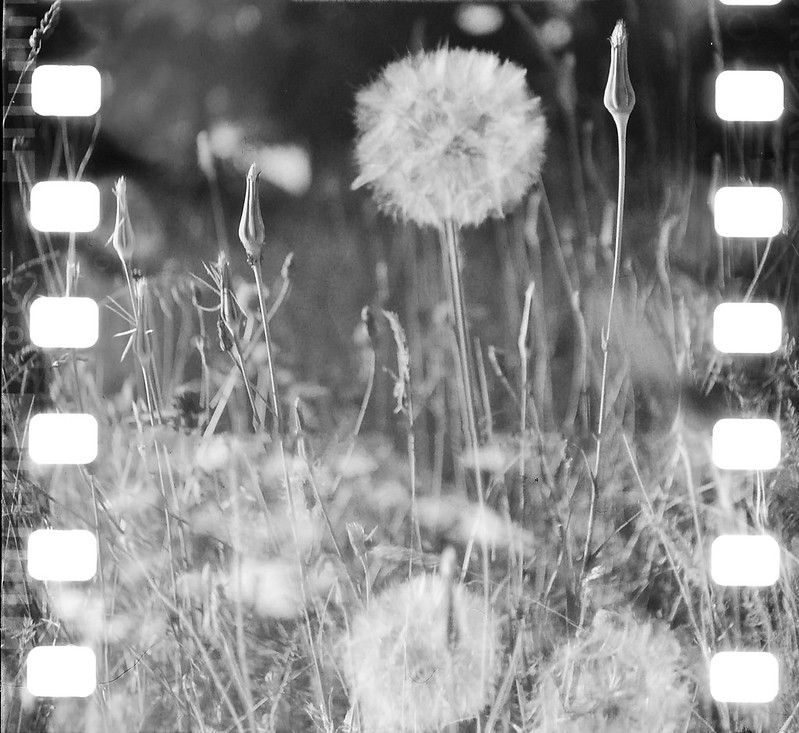
I was recently given a couple rolls of Svema FN200 film from the
Film Photography Project to test out. I didn't know if the film was fresh, which apparently it is, and what the nominal speed of it was, besides 200ASA being Box. I had, however, viewed Leslie Lazenby's images on her Flickr account, and saw that she had shot it at box, and developed in XTOL.
Not having XTOL, nor finding any useful information online on this film, I had to go it all from scratch.
I had D-76 in mind, and began the work of figuring out a time to use. But I began to consider... What Dilution? And if it's expired, then it'll have a fair amount of Base Fog in D-76. Having a sulphite rich developer is not a good idea for expired film, and I began to consider an old stand-by for unknown films. Rodinal 1+100... That started me thinking, and exploring more into a possible developer for this. I then went into doing some reading on this film, and found out it wasn't expired.
That lead me, again, back to D-76.
I also found some developer recipes and times for FN200 on the web, but I wasn't sure if this IS FN200, or some other different emulsion, and so I had to again, reconsider.
Finally I settled on a dilution that would be the best solution for the dilemma. Dilution M. Yup, my own concoction of HC-110 dilutions.
1ml of Syrup for every 250mL of water. And the kicker for this, I was going to be using a 225mL tank. Yup, I was going to go against what Kodak suggests for the minimal developer amount of 6mL of chemical for any mix. Then again, I have done this many times, without a single hitch, so why not.
Getting my mixture ready, film loaded into the SS tank on its reel, and I began the LONG process of developing the film. 60:00 long, with 1 minute inversions every 5 minutes.
The results were very nice! Great tonality, and a decent grain...
Again the roll of film went through my Canon A-1, and was matched off using the Canon 50mm ƒ/1.4 S. S. C. lens.. A Michael Raso favorite!
The more I see these old phones, the more I find them being left and vandalized. I guess it is becoming a less and less common site to see a phone, such as this, in use. The "Cell" phone revolution, I guess.
My wife and my Canon T-90. Strange, I don't remember seeing this roll of film for developing. Then again, I think I know why..
King's College Rd. and the University of Toronto Campus
Ori using his X-700 and a lens I gave him. The Minolta 58mm ƒ/1.4 Rokkor-MC. He didn't even know I took this photo. Well, until I let him see it!
She only asked, "As long as I look fabulous in the photo!" Funny, she looks great in the photo. Poor woman. Although down on her luck, she's definitely not down on her spirit!
Young love, perhaps? A couple of people who again, didn't see the camera. I think I am getting better at this whole Street Photography thing.
The best mode of Core transportation in an Urban Environment. Considering it is nimble, relatively fast, and ultimately, the most green option of transport. It doesn't pollute, and is easy to operate.
Too bad there are far too many idiots who give the good cyclists a bad name.
The few spoil it for the many. (Then again it's the Many who spoil it for the few in this case!)
Searching her bags. Another person who didn't see the glint of the camera lens pointed her way.
What do I think of this film?
Good question. You know, it's hard to say. I shot it at EI100, and ran it through a camera I know is very accurate with the meter, and has some of the very best optics money can buy. So it got a very good test, and you know what, I actually like it. But, here's the thing, I much prefer the slower FN64 instead. The tonality of this film, and the grain structure is like something from the 60's and 70's. A classic style emulsion for sure. The super thin emulsion makes it a beauty to scan, and it looks like it'll be just as easy to print. Plus, the best part, it dries perfectly flat!
How did you find the Latitude?
Another good question, and one that I cannot honestly answer fairly. The photos I took leads me to believe that the film has a fairly wide latitude indeed. I didn't get any highlights clipped, and I still got very good shadow detail. In fact, I am quite surprised with the amount of highlight and shadow detail that is retained. Then again, it COULD be the developing dilution I used, which can have a form of compensating effect, similar to using a weak Rodinal dilution.
As for recommending this film to friends, and family. Most definitely!
The film isn't as fine grained as, say, TMAX, or Delta films, but it is a very lovely grained film.
I could see it used as a portrait film, as well as a street photography film, as I did.
As for street photography vs the typical Tri-X solution, no. I cannot see it replacing Tri-X as the Street shooters choice, but hey, you can't expect miracles. Tri-X has just too strong, and long, a foothold in the Street and Journalism style.
But for portraits, I could really see this film excelling. It's not very contrasty, which is not a bad thing at all, as you can easily pump up the contrast when making a print, or even during the scan.
If you get a chance, you can pick up a roll of the
Svema фото 200 from the Film Photography store.
Until next time, keep those shutters firing!