Showing posts with label Grain. Show all posts

Wednesday, August 2, 2017

Found Film

Kodak Tri-X Found Film

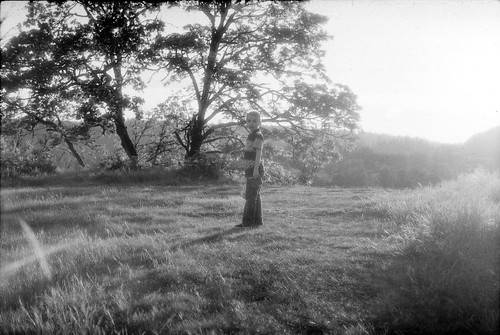
After buying a 4x5 Graphic film pack of Kodak Tri-X off EBAY I noticed it was on photo 10/16 when I got it.  So I did what I learned from experience shooting other old expired Tri-X. Rate for 50 and don't expect miracles.  Needless to say, I got more than I expected.  Not only did I find this, a previously exposed image from whoever originally owned this pack, but a super clean negative that I can really work with!  Just incredible.. When I pulled it out of the tank, I am telling you right now, the low amount of base-fog , you'd swear this was shot yesterday!  It's just that clear... Sure, you can see some degradation of the substrate and emulsion, but nothing that doesn't hurt the image at all.

Always amazed at the power of film!  This is one of the reasons i usually buy this old Tri-X. It's inexpensive and usually gives acceptable results with unique looks.


Friday, May 8, 2015

Roll Reversal - A Safe Alternative

Many people who know me know that I am all for experimentation with film.  One film I have done excessive amounts of experimentation with is Polypan F.  The one thing I have never done is REVERSAL of it.  I have done reversal with SCALA and Foma 100R (films made for reversal). And lets not forget the Kodak Cinecopy #5363 that I used.  


Soft Bokeh


The one problem with doing Reversals yourself is the harsh chemicals.  Potassium Permaganate is one thing (Found in fish medicine to treat Ich (pronounced Ick)).  The other chemical is Sulfuric Acid.  That is battery acid!  VERY bad chemical to have. It's ... well... acid!  Let's face it Acid is not person friendly, let alone safe and kid friendly!  Those with kids, not the easiest to have these kind of chemicals around.

The other option is to send to Dr5.com, which is a great way to get some absolutely stunning reversals!  However, what if you are not in a place where shipping a roll of film to DR5 is economical... What about doing it yourself without using harsh chemicals... Is there a way?

Apparently there is.  +Kelly-Shane Fuller, who is known for his E3 reversal in modern terms using HC-110 and C-41 to get E3 reversals with more stable colour dyes than the original E3 process...

Well.... lets look at his Chemically Safe B&W Reversal process..
For one, you use Hydrogen Peroxide (available the world over at drug stores) 3% which is as safe as it gets, considering you can pour it over an open wound to clean it out.  The other is Vinegar... Good old fashioned White Vinegar, which is a great thing... You can mix it to make a B&W bleach, or... pour it on your fries....

So he made a 260mL solution...  How?  Let's get into it;

250mL Hydrogen Peroxide 3%

10mL (2 tsp) White Vinegar
Heat to 150°F

So that's it...

Steps required;

Develop Film as normal using your favorite B&W developer...
BLEACH 6 Minutes
Fully Expose to light (take out of the container and off the reel)
Re-Develop to finality (you can reuse your Developer you poured out)
FIX

Wash
Photoflo
Dry

Then you get some beautiful slides!


B&W slide test 1
Kodachrome 64 (Expired) As B&W Slide
Yeah, that's right.  KODACHROME as a slide again! Sadly, no colour, but hey, a Kodachrome slide is something to behold!  Regardless of how it is...
B&W slide test 2


B&W slide test 3

Then there is Polypan F (care of your's truly)... It is absolutely stunning!  I couldn't believe the tonality he got out of itI sent him a few rolls of Polypan F down and he finally got around to trying it out... Man.... Not only did I get him hooked on Polypan (It's an easy thing to do) but he is stunned too over the amazing tonality and look of this film as a reversal.
I'm all for B&W reversal.. And the fact that you can now use a much much MUCH more kid friendly version of the bleach..

Thanks Kelly-Shane Fuller!  

Stay tuned as photos of the film on a light table and under room light to show they are "SLIDES" will be posted later..

Can't wait to try this process myself!!
So until next time... Let's keep those shutters firing!

All images were used with permission from the original author and are direct linked from his Flickr stream.
Images are protected under International Copyright Law.  Use without permission is strictly prohibited.

Saturday, January 3, 2015

Svema Photo-125 C-41

This is not the first post I have done on the Svema 125ASA C41 film.  It's fantastic!

I can easily compare it to Portra 160 for smoothness and grain structure.  But for colour palette, it is in a league of its own.  Portra 160 is wonderful, absolutely, but I will have to say that this Svema film makes it look pale in comparison.

After seeing the way it renders landscapes, I will never shoot Portra 160 again!  It just seems to be missing that little bit of something for it.
Portraits? Well, I cannot compare.  Sadly I haven't seen how this Svema 125 works with portraits under proper controlled light, but I'm sure it probably does very well.

The first roll I shot was in my T90, and I gave it as much of a fighting chance to prove itself as I could. Rated +1EV and slapped a very damn good (and sharp) lens in front of it (Vivitar 28mm ƒ/2.5).  The images were nothing short of stunning.

However, I loaded roll #2 in my Ricoh Mirai 35-135 camera.  This thing is bizarre!  Looking more like a weapon from the future, it is very well designed. The lens is one of the best lenses I've used as a Zoom!

Milk Thistle

So using the funniest looking camera in my collection, I have captured one of the best images I've taken of a flower, or any other kind of plant life..

There's a reason I rarely take out this camera.. I'm scared that one day I'll have an accident with it and be left without it.

It's just such a damn good camera!  Optically, and functionally...

Until next time.. Keep those shutters firing!

First post of 2015 - Stay Tuned.. More are coming!!

Thursday, May 29, 2014

Why I Shoot Large Format...

So there is a question put out there by some friends of mine.
Also, with +Alex Luyckx and +Mathew Marrash, who have both been asked similar questions, I have wondered this very thing myself.

Why do I shoot Large Format...

It's a complicated question, that is not easily answered.  One reason I can think of, is quite simple.  It is very relaxing.  I enjoy shooting formats like 35mm, and 120.. but there is something that feels too fast about those formats.  In a "never stop, never slow-down" world, I like the fact that there's something that cannot be done quickly.
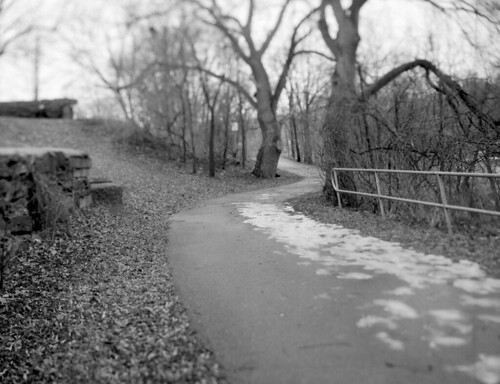
Winding..
"Winding" - Shanghai GP3

When I find myself looking for something far more relaxing and enjoyable than pointing a camera at a subject, and releasing the shutter without much though, I turn to my 4x5.  Sure, I wander around with a massive Monorail, but there is something about these amazing cameras.  They have immense capability.
The incredible amounts of movement on them, such as swing, tilt, shift, rise or fall, it gives a whole new dimension to the photo.

Take the image above.  I'm able to keep the path in focus, while throwing other areas, such as the trees at the top of the image, out of focus, keeping your eyes centered on the path moving through the image.

Plus you can take a single film, and change your entire Metering Index for each shot.  A 400 speed film can be 100, or even 800, giving different looks without ever changing your film.  Just change your developing.
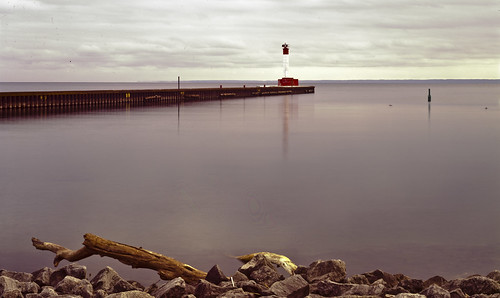

Oakville Lighthouse
"Oakville Lighthouse" - Fuji Provia 100F

When you shoot colour, it takes on a whole different dimension.  The detail begins to pop right out.
Colour takes on a whole new depth, and the clarity is unobtainable through any other means.  Sure, it's only 4x5, but if you take a look at a regular printed photograph that you get from your Local Walmart, from a digital or 35mm print, you'll notice that the print dimensions are 4x6.
Now imagine a negative, or a transparency, that is basically taken on a sheet of film that is just 1" narrower

than the 4x6 print.

To this day, I still remember the very first time I got my hands on my 4x5 Monorail.  Browsing the Kijiji website, I just so happened upon someone who was selling a Calumet CC400 with lensboard, case, 5 film holders, a pack of Fuji Provia 100F, and some other various stuff for a very inexpensive price.
All I needed was a lens, and I was ready to go!

So I popped onto that great auction site and got myself a Schneider-Kreuznach Symmar-S 210mm ƒ/5.6 Linhof lens for a price that I have never found again.

After I got the lens I designed, and made, my own lensboard. Painting the front Red, it really made it stand out.  The lensboard takes in the "Calumet" red dot logo and blends it seamlessly with the surrounding Bluish-Gray finish of the rest of the camera.

It really looks quite sharp!  Those that have seen the lensboard always remark at how lovely it looks.

The next lens I picked up was an old Kodak Ektar 127mm ƒ/4.7 Wide-Angle lens, commonly found on a Speed Graphic, such as what +Alex Luyckx has.  It has such a wide image circle, that I think it'll even cover 5x7 film!  It gives me movements on 4x5, and like many Kodak lenses, is incredibly sharp.
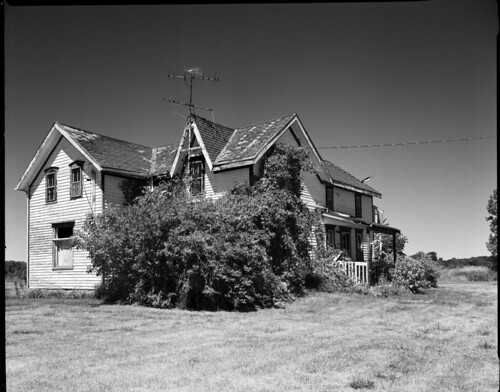
Rundown
"Rundown" - EFKE IR820C w/Red Filter (Kodak Ektar 127mm)
But that doesn't necessarily answer the question as to why I shoot large format.  And as I said, it's not a question easily answered.

Lets look at it a different way.  Why not shoot large format?  Well, simple.  The gear is heavy, cumbersome, expensive, and not easy to transport.
There are film holders, different lenses and boards, big heavy tripods, and enough movements to make your head spin.
But at the same time, when you are shooting a 35mm camera, or even that dSLR, you have a very limited perspective to think of.  Where, I find, Large Format lets you take a whole different perspective when shooting.
You can shoot at an angle, and by adjusting your lens angle you can get straight lines and correct perspectives.
Plus, you slow down.
In a world where the digital camera can fire off 30 frames in a few seconds, the large format camera lets you stop, relax, and focus.
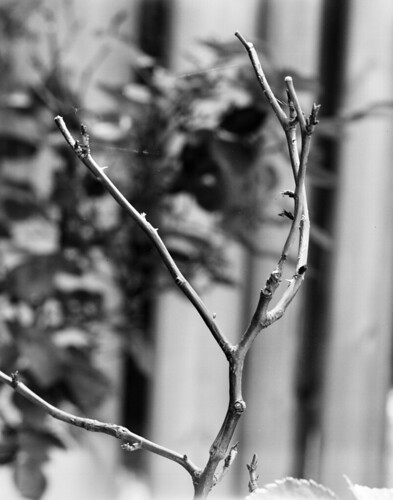
Spidersilk
"Spidersilk" - Fuji Provia 100F (Schneider-Kreuznach 210mm)
This image is probably a prime example of slowing down.  From start to finish it took me no less than 2 hours to get it set up.  After focusing I had to measure off the bellows and calculate the bellows factor.  That means adding stops to represent the amount of light lost from the lens to the film-plane due to the bellows extension.  This is done using a tape measure, or a guesstimate, of the lensboard to the film plane.  A 210mm lens will have a bellows draw of 210mm from the film plane to the lens at infinity.  This is the normal factor for the lens.  While you extend it beyond 210mm you have to increase the number of stops of light for your exposure.  Thankfully, instead of doing a bunch of math either in my head, or on paper, I have an app for that on my phone (yes there is an App for just about everything!).
Then you have to take a light reading.  Well, when I took this, the sun was blasting down through the sky and blowing some parts of the image out.  I was shooting a transparency after all, and wanted some of that powerful light to be behind some clouds.  So I waited.... and waited... and waited....

After what seemed an eternity (was just short of two hours) I found the sunlight starting to wane.. then finally that harsh glaring light softened down.
Quickly taking a ready, and factoring in the bellows draw, I dialed in the settings on my lens, and the shutter.
Loading the film holder, drawing out the darkslide, then releasing the shutter, I knew I had the image I was after.

It was then that disaster struck.  I forgot to label the holder properly, or note it in my book what was loaded.
So I ended up with this film being loaded into the tank along with many other B&W sheets to be processed in HC-110 Dil. H.

Sure enough, however, the image is nothing less than amazing.  Super smooth, and incredibly well toned!  I couldn't have gotten a better image if I tried.
It almost feels like it just works better in B&W than it ever could in colour.

My wife complains at times when I take the 4x5 our on a walk.  "Why are you taking that thing for?? It's so big and heavy, and takes you forever to take a single photo!"
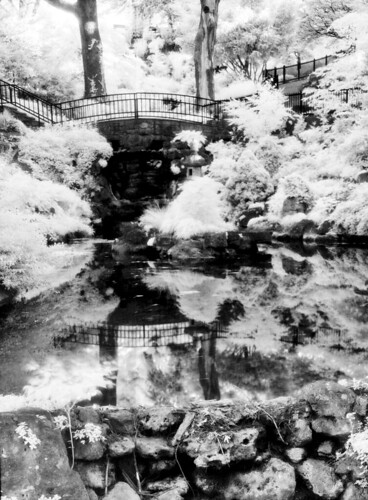
IR Garden
"IR Garden" - EFKE IR 820C Hoya R72 Filter
Well, again, you slow down, and you really pay attention to what you are going to take a photo of.  When I was at High Park, I imagined this water garden all aglow in IR light.
The image in my mind was perfect...
I lined it up in the camera, stopped down the lens, and just envisioned it.
Metering the shot as best as I could, I got the shutter ready and released it....

Tick... tick.... tick... tick....  45 seconds ticked by....... then finally 90 seconds was reached, which was right on the money for what I metered for, and I closed the shutter....
I knew instantly that i had exactly what I was after...

Sure enough, the image, when I got the film developed, popped out and stared at me.  The negative was just beautiful!

My very first IR image had been captured.. Unlike many others who shot their first IR on 35mm or even 120.. I did it on 4x5!  And I was absolutely in love with IR!  So much so that I bought a roll of Efke IR 820C in 35mm... It makes you slow down as well, shooting IR.

Then there is the old lenses that you find on old Kodak Folders, or the old Rapid Rectilinear lenses, or even Achromatic lenses.
These are dual element lenses that are either cemented together (Achromatic) or separated by a pocket of air (Rectilinear).  The difference is that the Rectilinear lenses are actually convertible.  Remove one of the elements and you can get a Telephoto effect, or a Wide-Angle effect.  Most often it's a "TELEPHOTO" effect.
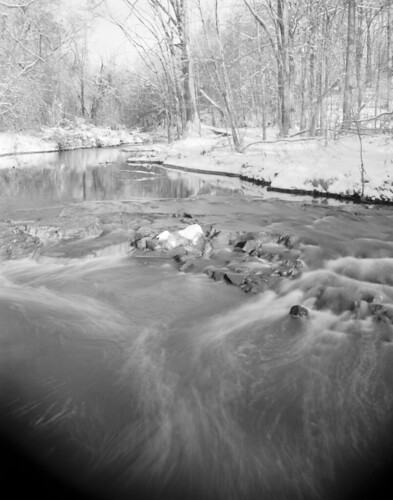
Running
"Running" - Ilford FP4+ (Kodak Rapid Rectilinear)
I had a couple of old Kodak folder cameras which were no longer functional, due to lack of film, or the bellows being far too holey to be used.  So I did what any sane person would do.  I remove the lenses for use on my 4x5.

And I can tell you right now, that was the best choice I could have made for these old cameras!  The camera is just a light tight box, but if I can't use it, why let the lens, which is a beautiful piece of workmanship, go to waste?

So I did some testing.  One of those tests was with some Ilford FP4+ and the lens during the winter.
Visiting one of my old haunts, the Trethewey Wetlands, I took a photo of the serene and glass-like Black Creek river.

What a beautiful site!  I knew that as soon as I closed the shutter I had the image that would make me remember about why I shoot 4x5 film.  Why large format is so special to me... and why I could never give it up....

Sure enough, this image has made its way onto my wall in the size of 11x14, but it doesn't even begin to do it justice.  It needs to be bigger.... 16x20?  Probably even bigger... It just had to be bigger!  It has so much immense detail, and has such a feeling of serenity and peacfulness.......  An image that can probably spend the next many years being reprinted over and over again..

But finally.... What I dare to dream of doing with my big camera...  Shoot portraits..
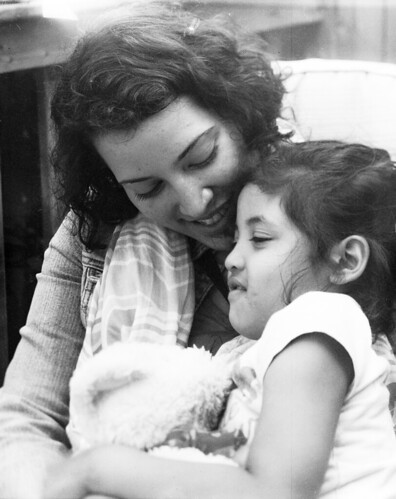
Mother & Daughter
"Mother and Daughter" Fomapan 400 (Schneider-Kreuznach 210mm)
This is what I truly love.  Portraits... Large format Portraits have such a different feeling.  Such a different relationship, and just give you a whole new meaning to slowing down.  You want to capture that moment at the right time, the right way.

This is one of them.  Sure, it's not the best for that "Candid" moment, but sometime the stars align, and you are able to capture that moment, just by being there, and being ready.
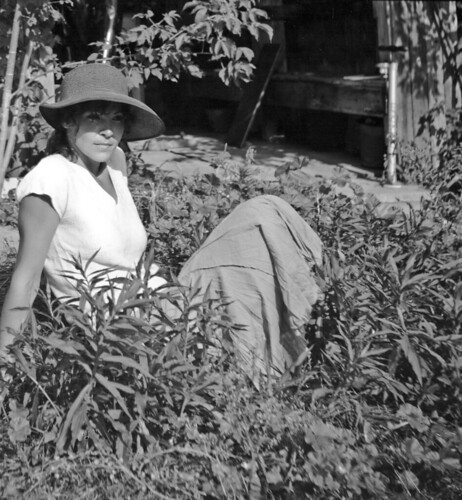
In The Field - Patricia
"In The Field" - EFKE IR820C (Baush & Lomb Rapid Rectilinear) No Filter
So remember that when you are shooting any format, digital, or film, try to take the idea that you're shooting a much larger scale.  Imagine, instead of shooting just a super simple sensor the size of a postage stamp, or a piece of 35mm film, that you are shooting something much larger.  The size of a print, where a single shot matters.

Then focus, and pay attention to your surroundings, the light, the position of your subject.  How the background portrays with your subject, and ultimately, what the photo means to you.  Does it tell a proper story?

Even when you shoot a digital format camera, you can easily just slow down, and relax.  Take a breather and visualize the image before you before you even take the photo...
It'll materialize in your head, and when it does, then release the shutter.

You'll be much happier when you do..
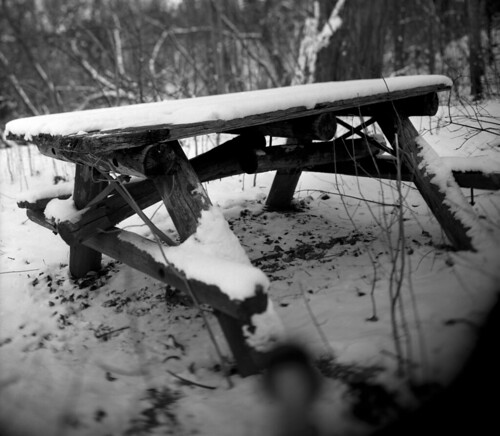
Ghostly Sitting
"Ghostly Sitting" - Shanghai GP3 (Carl Zeiss Jena 105mm)
Finally, like many, although this image still eludes me, the shot I have visualized many many many times over.  I have taken this photo probably a hundred times in my head, and this time I thought I had it.
I was so close, but again, the shot eluded me.

Sadly, this bench is no longer in this location, but has been moved... Now the image I must visualize again...
And hopefully one day, with the right equipment, I'll get the image I was after...

So why do I shoot Large Format Film?

The simplest answer is this...

Because it lets me imagine a world that perhaps doesn't exist.  A simpler world, where time slows down, or even stands still... even if it's just for a moment...


Until next time...  Keep those shutters firing!

Sunday, May 18, 2014

The Immense Power of Film

Seven stops.  That's a downright killer for Digital and Slide film.  Seven stops of over exposure will completely blow out mid-tones, highlights, and bring shadows to a point where they will become highlights.

Seven stops is unheard of for even getting an image with Slide and Digital, and yet.

Take IR film with an IR filter, and that's what you have to do.  Take the film's speed, and drop about 7 stops off the rated speed to account for the filter, and hope the light comes through enough on the film.  After all, IR light is a funny thing.

Using Rollei IR400, I was exposing for 3 to 6EI, which is between 6 and 7 stops over exposed.
This allows enough light to get through the filter and expose the film, giving an image.


"Humber Light" - Bronica ETRs - Zenzanon 75mm ƒ/2.8 @ ƒ/11 1/8s
As you can see it has an absolutely gorgeous look that standard B&W film just cannot see.  It is a wonderful effect.

Now that said, what happens when you meter for EI3 or EI6 and expose the film without remembering to attach the filter?

Well, what happens to a digital image 7 stops over exposed.
Why, you blow it out.  Basically you have no chance of saving even the tiniest bit of detail.

Well, this is the thing about Negative film.  It has such immense latitude that you can save images that are essentially blown to pieces.

"Broken" - Bronica ETRs - Zenzanon 75mm ƒ/2.8 @ ƒ/16 1/4s
I wondered the same thing.  I had shot this image, and as soon as it was finished exposing I looked down and noticed the filter still in my hand.  Yup, I shot this without attaching the filter to the camera.

I thought, "Nope.. I've lost this image.."
It was also the very last frame on the roll.  I know I had a whole roll of great images, but this one image was, well... lost!

Apparently, this film has such incredible power, incredible latitude, it is, for lack of a better word...  Incredible!

It blew my mind, not the highlights. Yes, I know that the some of the highlights ARE blown out, but considering that the detail in the mid-tones is still there, and there is still shadows, I cannot imagine this image even being remotely salvageable on anything but Film.

+Holger Drallmeyer had an oopsie where he forgot to attach the filter and blew out two sheets of IR film.
I suggested stand-developing in a Rodinal 1+200 mixture for 60 minutes to help even it all out.  But this was developed in Rodinal 1+50 for standard times, and it worked out .. well quite amazingly well!

For those that have accidentally done something similar and were not sure how to develop the film.  Well, why not try developing it normally. You never know, you might be surprised!

Until next time,  Keep those shutters firing!

Saturday, April 26, 2014

Svema FN200 First Look - FPP Tester Roll

I was recently given a couple rolls of Svema FN200 film from the Film Photography Project to test out.  I didn't know if the film was fresh, which apparently it is, and what the nominal speed of it was, besides 200ASA being Box.  I had, however, viewed Leslie Lazenby's images on her Flickr account, and saw that she had shot it at box, and developed in XTOL.
Not having XTOL, nor finding any useful information online on this film, I had to go it all from scratch.

I had D-76 in mind, and began the work of figuring out a time to use.  But I began to consider... What Dilution?  And if it's expired, then it'll have a fair amount of Base Fog in D-76.  Having a sulphite rich developer is not a good idea for expired film, and I began to consider an old stand-by for unknown films.  Rodinal 1+100...  That started me thinking, and exploring more into a possible developer for this.  I then went into doing some reading on this film, and found out it wasn't expired.
That lead me, again, back to D-76.

I also found some developer recipes and times for FN200 on the web, but I wasn't sure if this IS FN200, or some other different emulsion, and so I had to again, reconsider.

Finally I settled on a dilution that would be the best solution for the dilemma.  Dilution M.  Yup, my own concoction of HC-110 dilutions.

1ml of Syrup for every 250mL of water. And the kicker for this, I was going to be using a 225mL tank. Yup, I was going to go against what Kodak suggests for the minimal developer amount of 6mL of chemical for any mix.  Then again, I have done this many times, without a single hitch, so why not.

Getting my mixture ready, film loaded into the SS tank on its reel, and I began the LONG process of developing the film.  60:00 long, with 1 minute inversions every 5 minutes.

The results were very nice!  Great tonality, and a decent grain...

Again the roll of film went through my Canon A-1, and was matched off using the Canon 50mm ƒ/1.4 S. S. C. lens.. A Michael Raso favorite!


The more I see these old phones, the more I find them being left and vandalized.  I guess it is becoming a less and less common site to see a phone, such as this, in use. The "Cell" phone revolution, I guess.


My wife and my Canon T-90. Strange, I don't remember seeing this roll of film for developing. Then again, I think I know why..


King's College Rd. and the University of Toronto Campus


Ori using his X-700 and a lens I gave him.  The Minolta 58mm ƒ/1.4 Rokkor-MC. He didn't even know I took this photo.  Well, until I let him see it!


She only asked, "As long as I look fabulous in the photo!"  Funny, she looks great in the photo.  Poor woman.  Although down on her luck, she's definitely not down on her spirit!


Young love, perhaps?  A couple of people who again, didn't see the camera.  I think I am getting better at this whole Street Photography thing.


The best mode of Core transportation in an Urban Environment.  Considering it is nimble, relatively fast, and ultimately, the most green option of transport.  It doesn't pollute, and is easy to operate.
Too bad there are far too many idiots who give the good cyclists a bad name.
The few spoil it for the many.  (Then again it's the Many who spoil it for the few in this case!)


Searching her bags.  Another person who didn't see the glint of the camera lens pointed her way.


What do I think of this film?

Good question. You know, it's hard to say.  I shot it at EI100, and ran it through a camera I know is very accurate with the meter, and has some of the very best optics money can buy. So it got a very good test, and you know what, I actually like it. But, here's the thing, I much prefer the slower FN64 instead.  The tonality of this film, and the grain structure is like something from the 60's and 70's.  A classic style emulsion for sure. The super thin emulsion makes it a beauty to scan, and it looks like it'll be just as easy to print. Plus, the best part, it dries perfectly flat!

How did you find the Latitude?

Another good question, and one that I cannot honestly answer fairly.  The photos I took leads me to believe that the film has a fairly wide latitude indeed.  I didn't get any highlights clipped, and I still got very good shadow detail. In fact, I am quite surprised with the amount of highlight and shadow detail that is retained. Then again, it COULD be the developing dilution I used, which can have a form of compensating effect, similar to using a weak Rodinal dilution.

As for recommending this film to friends, and family.  Most definitely!
The film isn't as fine grained as, say, TMAX, or Delta films, but it is a very lovely grained film.
I could see it used as a portrait film, as well as a street photography film, as I did.

As for street photography vs the typical Tri-X solution, no.  I cannot see it replacing Tri-X as the Street shooters choice, but hey, you can't expect miracles.  Tri-X has just too strong, and long, a foothold in the Street and Journalism style.
But for portraits, I could really see this film excelling.  It's not very contrasty, which is not a bad thing at all, as you can easily pump up the contrast when making a print, or even during the scan.

If you get a chance, you can pick up a roll of the Svema фото 200 from the Film Photography store.

Until next time, keep those shutters firing!