 |
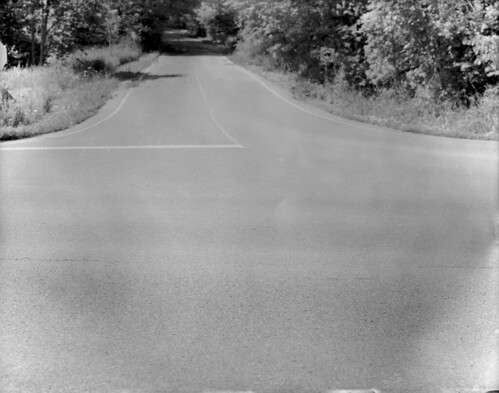
| Calumet CC400 4x5 Monorail - Schneider-Symmar 180mm ƒ/5.6 @ ƒ/16 - 11:48PM August 1, 2017 1s Exposure - Rollei RPX25 - HC-110 Dil. B 5:00 20°C |
Showing posts with label Kodak. Show all posts
Showing posts with label Kodak. Show all posts
Saturday, August 5, 2017
Empty Road
I took this photo as I have passed this spot several times, almost every single day to be exact, have wanted to shoot it very similar to how I did, however the issue has always been a matter of 'how to shoot it' and 'how to frame it'. I decided on having the road into the forest to be out of focus and the T junction to be in focus. I find that the back elements being in focus and the front elements, such as the road, if it was out it wouldn't have the same effect. At least in my mind, plus I didn't like how it looked when I had tested that in camera. It would have been a huge challenge to shoot this in 35mm the same way as I'm sure the focusing would have been a real trick and I doubt I would have got the same effect out of focus as I would here. Especially at around ƒ/16 or so, as I was here. Maybe the image isn't quite what I had in mind, but it's pretty close. I'll have to try this again when the fogs return.

Wednesday, April 5, 2017
Looking Up
So last weekend I tried something a little different for a change. Instead of just looking at what is around me and in front of me, while in Downtown Toronto, I decided to try... looking up... for a different perspective on things..
The results I got were actually quite inspiring. I think I like this idea of upward perspective photography.. It makes you really take a different approach to how you view things..
I'm really impressed with how everything turned out. I think I'll do a bit more of this whole.. shooting up thing. heh..
Anyway.. Until next time, keep those shutters firing!
The results I got were actually quite inspiring. I think I like this idea of upward perspective photography.. It makes you really take a different approach to how you view things..
 |
Canon T90 - Canon 35-105mm ƒ/3.5 - Kodak Tri-X 400 - SPUR-HRX 1+17 |
 |
| Canon T90 - Osawa 24mm ƒ/2.8 - Kodak Tri-X - SPUR-HRX 1+17 |
 |
| Canon T90 - Osawa 24mm ƒ/2.8 - Kodak Tri-X - SPUR-HRX 1+17 |
 |
| Canon T90 - Osawa 24mm ƒ/2.8 - Kodak Tri-X - SPUR-HRX 1+17 |
 |
| Canon T90 - Osawa 24mm ƒ/2.8 - Kodak Tri-X - SPUR-HRX 1+17 |
 |
| Canon T90 - Canon 35-105mm ƒ/3.5 - Kodak Tri-X - HC-110 Dil. B |
 |
| Canon T90 - Canon 35-105mm ƒ/3.5 - Kodak Tri-X - HC-110 Dil. B |
Anyway.. Until next time, keep those shutters firing!
Saturday, October 10, 2015
A Post In A While
Thankfully I have my trust Nokia Lumia 1020 mobile camera phone with me so I can get some shooting done when I have a moment or two, but I would love to have a go-to film camera more often than not. But sadly they are a bit restrictive and bulky for my job. Quite simply it would be too difficult for me to work with a film camera instead of my phone.
However a recent film shooters meetup and walk (summer 2015) took us to St. Lawrence Market and the surrounding area over to C'est What bar and grill. It is a absolutely lovely place to grab a bite and a pint.
Oh incidentally my wife and I have also gone completely Vegan. Don't know what that is? Look it up!
www.vegan.com
I won't bore you with those details, I'll talk strictly about the shooting I did at St. Lawrence Market. It was great fun, but a little.... crazy..!
I shot some CBEMA (Svema) FN64 rated at 200 there (which came out stunning btw) and some wonderful Porta 800! That film is amazing. No, not in 35mm... 120!
I have been finding myself more drifting to 120 instead of 135 lately, just simply because I prefer the lower number of frames and larger sized frames. It makes such a difference having such massive film (at least to me).
 |
| Midday Meal - Zenza Bronica SQ-Ai - 80mm ƒ/2.8 - Portra800 |
 |
| Main Entrance - Zenza Bronica SQ-Ai - 80mm ƒ/2.8 - Portra 800 |
The market is beautiful inside and quite chaotic, but it makes for some interesting photo opportunities. I thoroughly enjoyed it, but it was the outdoor shots that I enjoyed most!
When we left the Market and wandered about Downtown Toronto I got to try out street photography with a medium format SLR! Go figure!
When we left the Market and wandered about Downtown Toronto I got to try out street photography with a medium format SLR! Go figure!
 |
| The Odd Couple - Zenza Bronica SQ-Ai - 80mm ƒ/2.8 - Portra800 |
Not the easiest thing to do, shooting street photography with such a big camera, but I managed to, as these people didn't even have the slightest clue that I had even taken their photo, another plus for Waist Level Finders...
 |
| The Lady With The Lilac Parasol - Zenza Bronica SQ-Ai - 80mm ƒ/2.8 - Portra800 |
The shot above literally took more than 10 minutes to take. I had it all lined up at one point, but then other people started to show up in the shot and I had to wait. I didn't want random people pollution in the photo, so I waited and waited and waited...
Then this lady started walking toward me and the moment arrived... She was the sole person in the shot and actually stood out just enough to give this more than a landscape shot...
I tripped the shutter and perfect! I knew I had nailed the perfect photo..
Then this lady started walking toward me and the moment arrived... She was the sole person in the shot and actually stood out just enough to give this more than a landscape shot...
I tripped the shutter and perfect! I knew I had nailed the perfect photo..
 |
| Across The Bar - Zenza Bronica SQ-Ai - 80mm ƒ/2.8 - Portra800 |
Yeah, we ended up at a bar/pub after.. We always do for 'after-walk' refreshments, which means beer.. It was fantastic! We got fries and a beer, of course. +Alex Luyckx, the organizer of the walk, let my wife wander around with a Hasselblad. Lucky gal!
However my wife decided on a coke instead... but I couldn't have framed this photo any better..
So yes, I am still active, just haven't been updating my blog often enough. I hope to rectify that soon and get some more Camera Reviews as well..
Until next time... Keep those shutters firing!
 |
| Well Crafted - Zenza Bronica SQ-Ai - 80mm ƒ/2.8 - Protra800 |
So yes, I am still active, just haven't been updating my blog often enough. I hope to rectify that soon and get some more Camera Reviews as well..
Until next time... Keep those shutters firing!
Tuesday, October 14, 2014
Film Is Not Dead
Film... A concept that has been around for over 100 years, and has just gotten better and better over the years. Sure, there have been trials with it. Disc film.. 110.. Even APS film was tried and failed. Strangely enough, 110 film made a comeback in 2013!
Many people shot 110, including myself when I was much younger, and really enjoyed it.
Some even considered it a serious enough format to use it at weddings. Considering the Pentax Auto110 system, it was used at weddings, but I don't think it was a very common practice for all photographers.
Most 110 cameras were just simple snapshot cameras, like the Brownies of yesteryear.
I don't shoot 110 today, but 135 (also known as 35mm) 120, and 4x5.
Recently I made a contribution to a company known as "Ferrania Film" which is an Italian film manufacturer. They made 110, 126, 135, 120 and even 4x5 films until they shut down half a decade ago.
Strangely they saved their mothballed machines from destruction and launched a Kickstarter campaign to bring their production back online.
A new E6 film in both 135 and 120 formats!
Unlike Kodak, who completely left so many photographers gasping as they completely axed their entire E6 lineup and gave the market to Fuji, who is also axing many of their films, Ferrania is re-entering the market with a Colour slide film right from the get go!
Then there's The Impossible Project. A company in The Netherlands who purchased the last remaining Polaroid factory, and saved it from demolition. After purchase, they had to literally start from scratch! Their own formula, their own dyes, chemicals, process and packaging. They had to reinvent... Polaroid Instant photography!
Yet they are another resounding success story!
From the venerable SX-70 series of cameras, to the P600s and even Spectras. They survive, and sell well. They are also manufacturing and selling 8x10 instant film!
How about that? In a digital world, Instant Film is still being made, and sold in sizes that the average person doesn't even print at!
Then there's the Film Photography Project. They have become a source of film knowledge, and a source of even film itself! With rare types of film, like E6 Infrared, to Svema, and even Cinefilm types, like Eastman Double-XX, or Eastman 5363 High Contrast film. Amazing stocks, and readily available in 35mm rolls (or 100' bulk rolls) from the Film Photography Project store!
Have you ever walked into a antique store and found an old Brownie camera that took 620 film, but didn't know where to get that film for it because, well, 620 film is no longer manufactured?
Actually, it is. 620 film never stopped being manufactured, but the spools did. 620 film is just 120 film on a smaller thinner spool. If you purchase that 620 camera you can get a spool inside that camera. Purchase a roll of 120 film, and by pulling the spool out of it (in the dark of course) you can roll the film up tighter and fit it inside the camera without the spool in place.
Then feed the 120 film paper into the take up 620 spool..
Line it all up, and close the camera up.
Flick the lights on, advance to frame #1, and you're ready to go!
Or there's another option. The Film Photography Project is producing NEW 620 spools through a plastic extruder and loading 120 film onto it for sale to you!
There are even other companies starting out.. CineSTILL is growing, and putting the Vision line of films in 120 format!
Can you imagine? They are phenomenal films, and in 35 are gorgeous, but 120? Stellar!
So before you count film down and out, think again. It's here to stay, and so long as there are people buying it, it'll stay here!
Now get out there and support film.
ILFORD, KODAK, FUJI, ADOX, FERRANIA, ROLLEI, AGFA, SHANGHAI
Start shooting, and enjoy it! Film cameras have never been as low of price as they are now.
A Mechanical Film Camera will last you a lifetime, giving you the same results as you can expect every time!
Imperfect, organic and tangible beautiful images!
Film.... Is.... Not.... Dead!
Many people shot 110, including myself when I was much younger, and really enjoyed it.
Some even considered it a serious enough format to use it at weddings. Considering the Pentax Auto110 system, it was used at weddings, but I don't think it was a very common practice for all photographers.
Most 110 cameras were just simple snapshot cameras, like the Brownies of yesteryear.
I don't shoot 110 today, but 135 (also known as 35mm) 120, and 4x5.
Recently I made a contribution to a company known as "Ferrania Film" which is an Italian film manufacturer. They made 110, 126, 135, 120 and even 4x5 films until they shut down half a decade ago.
Strangely they saved their mothballed machines from destruction and launched a Kickstarter campaign to bring their production back online.
A new E6 film in both 135 and 120 formats!
Unlike Kodak, who completely left so many photographers gasping as they completely axed their entire E6 lineup and gave the market to Fuji, who is also axing many of their films, Ferrania is re-entering the market with a Colour slide film right from the get go!
Then there's The Impossible Project. A company in The Netherlands who purchased the last remaining Polaroid factory, and saved it from demolition. After purchase, they had to literally start from scratch! Their own formula, their own dyes, chemicals, process and packaging. They had to reinvent... Polaroid Instant photography!
Yet they are another resounding success story!
From the venerable SX-70 series of cameras, to the P600s and even Spectras. They survive, and sell well. They are also manufacturing and selling 8x10 instant film!
How about that? In a digital world, Instant Film is still being made, and sold in sizes that the average person doesn't even print at!
Then there's the Film Photography Project. They have become a source of film knowledge, and a source of even film itself! With rare types of film, like E6 Infrared, to Svema, and even Cinefilm types, like Eastman Double-XX, or Eastman 5363 High Contrast film. Amazing stocks, and readily available in 35mm rolls (or 100' bulk rolls) from the Film Photography Project store!
Have you ever walked into a antique store and found an old Brownie camera that took 620 film, but didn't know where to get that film for it because, well, 620 film is no longer manufactured?
Actually, it is. 620 film never stopped being manufactured, but the spools did. 620 film is just 120 film on a smaller thinner spool. If you purchase that 620 camera you can get a spool inside that camera. Purchase a roll of 120 film, and by pulling the spool out of it (in the dark of course) you can roll the film up tighter and fit it inside the camera without the spool in place.
Then feed the 120 film paper into the take up 620 spool..
Line it all up, and close the camera up.
Flick the lights on, advance to frame #1, and you're ready to go!
Or there's another option. The Film Photography Project is producing NEW 620 spools through a plastic extruder and loading 120 film onto it for sale to you!
There are even other companies starting out.. CineSTILL is growing, and putting the Vision line of films in 120 format!
Can you imagine? They are phenomenal films, and in 35 are gorgeous, but 120? Stellar!
So before you count film down and out, think again. It's here to stay, and so long as there are people buying it, it'll stay here!
Now get out there and support film.
ILFORD, KODAK, FUJI, ADOX, FERRANIA, ROLLEI, AGFA, SHANGHAI
Start shooting, and enjoy it! Film cameras have never been as low of price as they are now.
A Mechanical Film Camera will last you a lifetime, giving you the same results as you can expect every time!
Imperfect, organic and tangible beautiful images!
Film.... Is.... Not.... Dead!
Thursday, May 29, 2014
Why I Shoot Large Format...
So there is a question put out there by some friends of mine.
Also, with +Alex Luyckx and +Mathew Marrash, who have both been asked similar questions, I have wondered this very thing myself.
Why do I shoot Large Format...
It's a complicated question, that is not easily answered. One reason I can think of, is quite simple. It is very relaxing. I enjoy shooting formats like 35mm, and 120.. but there is something that feels too fast about those formats. In a "never stop, never slow-down" world, I like the fact that there's something that cannot be done quickly.
When you shoot colour, it takes on a whole different dimension. The detail begins to pop right out.
Colour takes on a whole new depth, and the clarity is unobtainable through any other means. Sure, it's only 4x5, but if you take a look at a regular printed photograph that you get from your Local Walmart, from a digital or 35mm print, you'll notice that the print dimensions are 4x6.
Now imagine a negative, or a transparency, that is basically taken on a sheet of film that is just 1" narrower
than the 4x6 print.
To this day, I still remember the very first time I got my hands on my 4x5 Monorail. Browsing the Kijiji website, I just so happened upon someone who was selling a Calumet CC400 with lensboard, case, 5 film holders, a pack of Fuji Provia 100F, and some other various stuff for a very inexpensive price.
All I needed was a lens, and I was ready to go!
So I popped onto that great auction site and got myself a Schneider-Kreuznach Symmar-S 210mm ƒ/5.6 Linhof lens for a price that I have never found again.
After I got the lens I designed, and made, my own lensboard. Painting the front Red, it really made it stand out. The lensboard takes in the "Calumet" red dot logo and blends it seamlessly with the surrounding Bluish-Gray finish of the rest of the camera.
It really looks quite sharp! Those that have seen the lensboard always remark at how lovely it looks.
The next lens I picked up was an old Kodak Ektar 127mm ƒ/4.7 Wide-Angle lens, commonly found on a Speed Graphic, such as what +Alex Luyckx has. It has such a wide image circle, that I think it'll even cover 5x7 film! It gives me movements on 4x5, and like many Kodak lenses, is incredibly sharp.
But that doesn't necessarily answer the question as to why I shoot large format. And as I said, it's not a question easily answered.
Lets look at it a different way. Why not shoot large format? Well, simple. The gear is heavy, cumbersome, expensive, and not easy to transport.
There are film holders, different lenses and boards, big heavy tripods, and enough movements to make your head spin.
But at the same time, when you are shooting a 35mm camera, or even that dSLR, you have a very limited perspective to think of. Where, I find, Large Format lets you take a whole different perspective when shooting.
You can shoot at an angle, and by adjusting your lens angle you can get straight lines and correct perspectives.
Plus, you slow down.
In a world where the digital camera can fire off 30 frames in a few seconds, the large format camera lets you stop, relax, and focus.
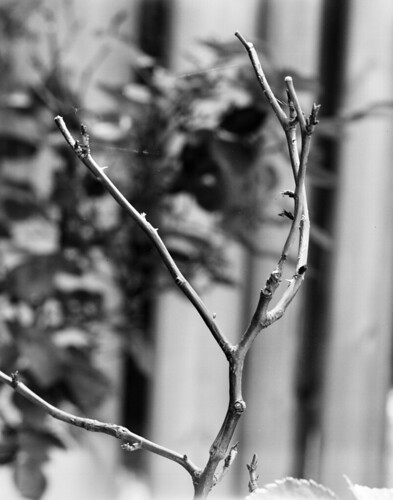
This image is probably a prime example of slowing down. From start to finish it took me no less than 2 hours to get it set up. After focusing I had to measure off the bellows and calculate the bellows factor. That means adding stops to represent the amount of light lost from the lens to the film-plane due to the bellows extension. This is done using a tape measure, or a guesstimate, of the lensboard to the film plane. A 210mm lens will have a bellows draw of 210mm from the film plane to the lens at infinity. This is the normal factor for the lens. While you extend it beyond 210mm you have to increase the number of stops of light for your exposure. Thankfully, instead of doing a bunch of math either in my head, or on paper, I have an app for that on my phone (yes there is an App for just about everything!).
Then you have to take a light reading. Well, when I took this, the sun was blasting down through the sky and blowing some parts of the image out. I was shooting a transparency after all, and wanted some of that powerful light to be behind some clouds. So I waited.... and waited... and waited....
After what seemed an eternity (was just short of two hours) I found the sunlight starting to wane.. then finally that harsh glaring light softened down.
Quickly taking a ready, and factoring in the bellows draw, I dialed in the settings on my lens, and the shutter.
Loading the film holder, drawing out the darkslide, then releasing the shutter, I knew I had the image I was after.
It was then that disaster struck. I forgot to label the holder properly, or note it in my book what was loaded.
So I ended up with this film being loaded into the tank along with many other B&W sheets to be processed in HC-110 Dil. H.
Sure enough, however, the image is nothing less than amazing. Super smooth, and incredibly well toned! I couldn't have gotten a better image if I tried.
It almost feels like it just works better in B&W than it ever could in colour.
My wife complains at times when I take the 4x5 our on a walk. "Why are you taking that thing for?? It's so big and heavy, and takes you forever to take a single photo!"
Well, again, you slow down, and you really pay attention to what you are going to take a photo of. When I was at High Park, I imagined this water garden all aglow in IR light.
The image in my mind was perfect...
I lined it up in the camera, stopped down the lens, and just envisioned it.
Metering the shot as best as I could, I got the shutter ready and released it....
Tick... tick.... tick... tick.... 45 seconds ticked by....... then finally 90 seconds was reached, which was right on the money for what I metered for, and I closed the shutter....
I knew instantly that i had exactly what I was after...
Sure enough, the image, when I got the film developed, popped out and stared at me. The negative was just beautiful!
My very first IR image had been captured.. Unlike many others who shot their first IR on 35mm or even 120.. I did it on 4x5! And I was absolutely in love with IR! So much so that I bought a roll of Efke IR 820C in 35mm... It makes you slow down as well, shooting IR.
Then there is the old lenses that you find on old Kodak Folders, or the old Rapid Rectilinear lenses, or even Achromatic lenses.
These are dual element lenses that are either cemented together (Achromatic) or separated by a pocket of air (Rectilinear). The difference is that the Rectilinear lenses are actually convertible. Remove one of the elements and you can get a Telephoto effect, or a Wide-Angle effect. Most often it's a "TELEPHOTO" effect.
I had a couple of old Kodak folder cameras which were no longer functional, due to lack of film, or the bellows being far too holey to be used. So I did what any sane person would do. I remove the lenses for use on my 4x5.
And I can tell you right now, that was the best choice I could have made for these old cameras! The camera is just a light tight box, but if I can't use it, why let the lens, which is a beautiful piece of workmanship, go to waste?
So I did some testing. One of those tests was with some Ilford FP4+ and the lens during the winter.
Visiting one of my old haunts, the Trethewey Wetlands, I took a photo of the serene and glass-like Black Creek river.
What a beautiful site! I knew that as soon as I closed the shutter I had the image that would make me remember about why I shoot 4x5 film. Why large format is so special to me... and why I could never give it up....
Sure enough, this image has made its way onto my wall in the size of 11x14, but it doesn't even begin to do it justice. It needs to be bigger.... 16x20? Probably even bigger... It just had to be bigger! It has so much immense detail, and has such a feeling of serenity and peacfulness....... An image that can probably spend the next many years being reprinted over and over again..
But finally.... What I dare to dream of doing with my big camera... Shoot portraits..
This is what I truly love. Portraits... Large format Portraits have such a different feeling. Such a different relationship, and just give you a whole new meaning to slowing down. You want to capture that moment at the right time, the right way.
This is one of them. Sure, it's not the best for that "Candid" moment, but sometime the stars align, and you are able to capture that moment, just by being there, and being ready.
So remember that when you are shooting any format, digital, or film, try to take the idea that you're shooting a much larger scale. Imagine, instead of shooting just a super simple sensor the size of a postage stamp, or a piece of 35mm film, that you are shooting something much larger. The size of a print, where a single shot matters.
Then focus, and pay attention to your surroundings, the light, the position of your subject. How the background portrays with your subject, and ultimately, what the photo means to you. Does it tell a proper story?
Even when you shoot a digital format camera, you can easily just slow down, and relax. Take a breather and visualize the image before you before you even take the photo...
It'll materialize in your head, and when it does, then release the shutter.
You'll be much happier when you do..
Finally, like many, although this image still eludes me, the shot I have visualized many many many times over. I have taken this photo probably a hundred times in my head, and this time I thought I had it.
I was so close, but again, the shot eluded me.
Sadly, this bench is no longer in this location, but has been moved... Now the image I must visualize again...
And hopefully one day, with the right equipment, I'll get the image I was after...
So why do I shoot Large Format Film?
The simplest answer is this...
Because it lets me imagine a world that perhaps doesn't exist. A simpler world, where time slows down, or even stands still... even if it's just for a moment...
Until next time... Keep those shutters firing!
Also, with +Alex Luyckx and +Mathew Marrash, who have both been asked similar questions, I have wondered this very thing myself.
Why do I shoot Large Format...
It's a complicated question, that is not easily answered. One reason I can think of, is quite simple. It is very relaxing. I enjoy shooting formats like 35mm, and 120.. but there is something that feels too fast about those formats. In a "never stop, never slow-down" world, I like the fact that there's something that cannot be done quickly.
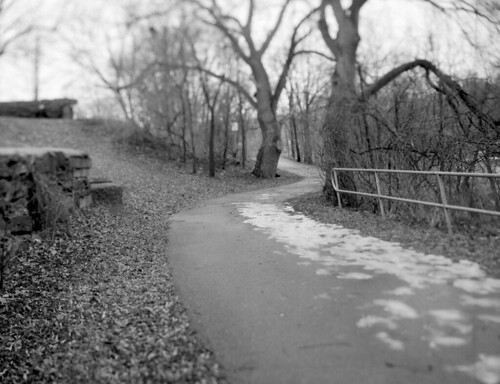 |
| "Winding" - Shanghai GP3 |
When I find myself looking for something far more relaxing and enjoyable than pointing a camera at a subject, and releasing the shutter without much though, I turn to my 4x5. Sure, I wander around with a massive Monorail, but there is something about these amazing cameras. They have immense capability.
The incredible amounts of movement on them, such as swing, tilt, shift, rise or fall, it gives a whole new dimension to the photo.
Take the image above. I'm able to keep the path in focus, while throwing other areas, such as the trees at the top of the image, out of focus, keeping your eyes centered on the path moving through the image.
Plus you can take a single film, and change your entire Metering Index for each shot. A 400 speed film can be 100, or even 800, giving different looks without ever changing your film. Just change your developing.
The incredible amounts of movement on them, such as swing, tilt, shift, rise or fall, it gives a whole new dimension to the photo.
Take the image above. I'm able to keep the path in focus, while throwing other areas, such as the trees at the top of the image, out of focus, keeping your eyes centered on the path moving through the image.
Plus you can take a single film, and change your entire Metering Index for each shot. A 400 speed film can be 100, or even 800, giving different looks without ever changing your film. Just change your developing.
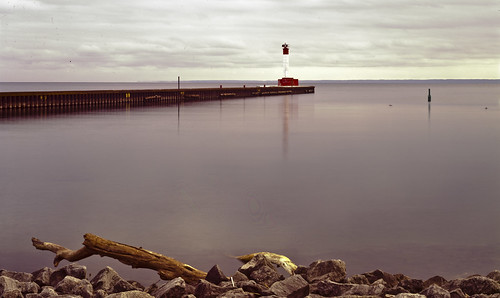 |
| "Oakville Lighthouse" - Fuji Provia 100F |
When you shoot colour, it takes on a whole different dimension. The detail begins to pop right out.
Colour takes on a whole new depth, and the clarity is unobtainable through any other means. Sure, it's only 4x5, but if you take a look at a regular printed photograph that you get from your Local Walmart, from a digital or 35mm print, you'll notice that the print dimensions are 4x6.
Now imagine a negative, or a transparency, that is basically taken on a sheet of film that is just 1" narrower
than the 4x6 print.
To this day, I still remember the very first time I got my hands on my 4x5 Monorail. Browsing the Kijiji website, I just so happened upon someone who was selling a Calumet CC400 with lensboard, case, 5 film holders, a pack of Fuji Provia 100F, and some other various stuff for a very inexpensive price.
All I needed was a lens, and I was ready to go!
So I popped onto that great auction site and got myself a Schneider-Kreuznach Symmar-S 210mm ƒ/5.6 Linhof lens for a price that I have never found again.
After I got the lens I designed, and made, my own lensboard. Painting the front Red, it really made it stand out. The lensboard takes in the "Calumet" red dot logo and blends it seamlessly with the surrounding Bluish-Gray finish of the rest of the camera.
It really looks quite sharp! Those that have seen the lensboard always remark at how lovely it looks.
The next lens I picked up was an old Kodak Ektar 127mm ƒ/4.7 Wide-Angle lens, commonly found on a Speed Graphic, such as what +Alex Luyckx has. It has such a wide image circle, that I think it'll even cover 5x7 film! It gives me movements on 4x5, and like many Kodak lenses, is incredibly sharp.
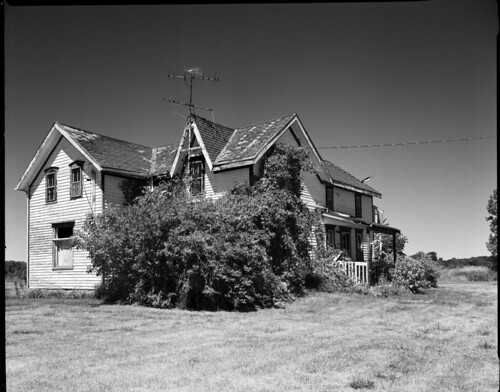 |
| "Rundown" - EFKE IR820C w/Red Filter (Kodak Ektar 127mm) |
Lets look at it a different way. Why not shoot large format? Well, simple. The gear is heavy, cumbersome, expensive, and not easy to transport.
There are film holders, different lenses and boards, big heavy tripods, and enough movements to make your head spin.
But at the same time, when you are shooting a 35mm camera, or even that dSLR, you have a very limited perspective to think of. Where, I find, Large Format lets you take a whole different perspective when shooting.
You can shoot at an angle, and by adjusting your lens angle you can get straight lines and correct perspectives.
Plus, you slow down.
In a world where the digital camera can fire off 30 frames in a few seconds, the large format camera lets you stop, relax, and focus.
 |
| "Spidersilk" - Fuji Provia 100F (Schneider-Kreuznach 210mm) |
Then you have to take a light reading. Well, when I took this, the sun was blasting down through the sky and blowing some parts of the image out. I was shooting a transparency after all, and wanted some of that powerful light to be behind some clouds. So I waited.... and waited... and waited....
After what seemed an eternity (was just short of two hours) I found the sunlight starting to wane.. then finally that harsh glaring light softened down.
Quickly taking a ready, and factoring in the bellows draw, I dialed in the settings on my lens, and the shutter.
Loading the film holder, drawing out the darkslide, then releasing the shutter, I knew I had the image I was after.
It was then that disaster struck. I forgot to label the holder properly, or note it in my book what was loaded.
So I ended up with this film being loaded into the tank along with many other B&W sheets to be processed in HC-110 Dil. H.
Sure enough, however, the image is nothing less than amazing. Super smooth, and incredibly well toned! I couldn't have gotten a better image if I tried.
It almost feels like it just works better in B&W than it ever could in colour.
My wife complains at times when I take the 4x5 our on a walk. "Why are you taking that thing for?? It's so big and heavy, and takes you forever to take a single photo!"
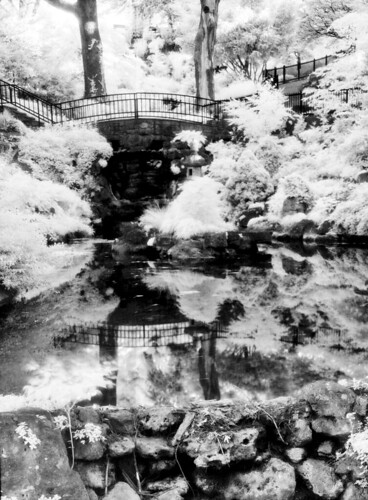 |
| "IR Garden" - EFKE IR 820C Hoya R72 Filter |
The image in my mind was perfect...
I lined it up in the camera, stopped down the lens, and just envisioned it.
Metering the shot as best as I could, I got the shutter ready and released it....
Tick... tick.... tick... tick.... 45 seconds ticked by....... then finally 90 seconds was reached, which was right on the money for what I metered for, and I closed the shutter....
I knew instantly that i had exactly what I was after...
Sure enough, the image, when I got the film developed, popped out and stared at me. The negative was just beautiful!
My very first IR image had been captured.. Unlike many others who shot their first IR on 35mm or even 120.. I did it on 4x5! And I was absolutely in love with IR! So much so that I bought a roll of Efke IR 820C in 35mm... It makes you slow down as well, shooting IR.
Then there is the old lenses that you find on old Kodak Folders, or the old Rapid Rectilinear lenses, or even Achromatic lenses.
These are dual element lenses that are either cemented together (Achromatic) or separated by a pocket of air (Rectilinear). The difference is that the Rectilinear lenses are actually convertible. Remove one of the elements and you can get a Telephoto effect, or a Wide-Angle effect. Most often it's a "TELEPHOTO" effect.
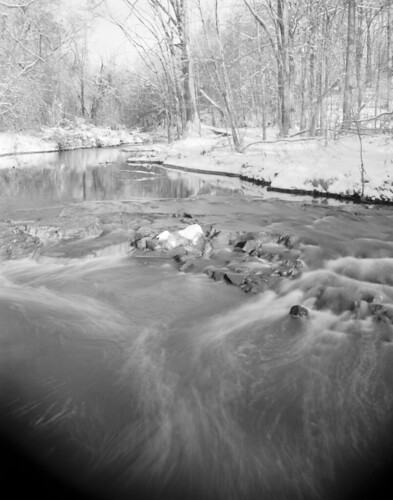 |
| "Running" - Ilford FP4+ (Kodak Rapid Rectilinear) |
And I can tell you right now, that was the best choice I could have made for these old cameras! The camera is just a light tight box, but if I can't use it, why let the lens, which is a beautiful piece of workmanship, go to waste?
So I did some testing. One of those tests was with some Ilford FP4+ and the lens during the winter.
Visiting one of my old haunts, the Trethewey Wetlands, I took a photo of the serene and glass-like Black Creek river.
What a beautiful site! I knew that as soon as I closed the shutter I had the image that would make me remember about why I shoot 4x5 film. Why large format is so special to me... and why I could never give it up....
Sure enough, this image has made its way onto my wall in the size of 11x14, but it doesn't even begin to do it justice. It needs to be bigger.... 16x20? Probably even bigger... It just had to be bigger! It has so much immense detail, and has such a feeling of serenity and peacfulness....... An image that can probably spend the next many years being reprinted over and over again..
But finally.... What I dare to dream of doing with my big camera... Shoot portraits..
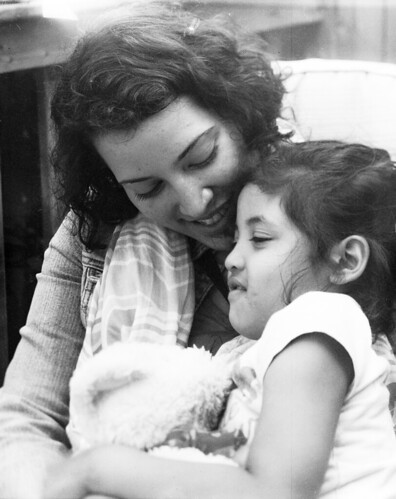 |
| "Mother and Daughter" Fomapan 400 (Schneider-Kreuznach 210mm) |
This is one of them. Sure, it's not the best for that "Candid" moment, but sometime the stars align, and you are able to capture that moment, just by being there, and being ready.
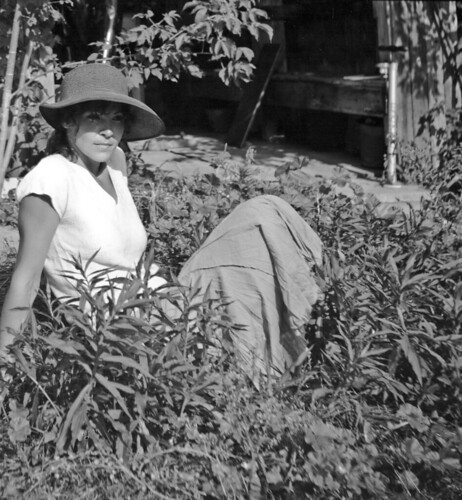 |
| "In The Field" - EFKE IR820C (Baush & Lomb Rapid Rectilinear) No Filter |
Then focus, and pay attention to your surroundings, the light, the position of your subject. How the background portrays with your subject, and ultimately, what the photo means to you. Does it tell a proper story?
Even when you shoot a digital format camera, you can easily just slow down, and relax. Take a breather and visualize the image before you before you even take the photo...
It'll materialize in your head, and when it does, then release the shutter.
You'll be much happier when you do..
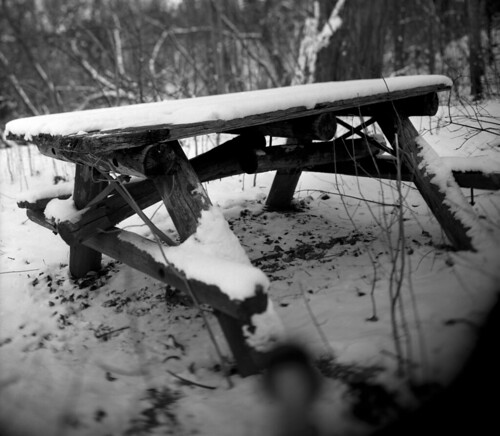 |
| "Ghostly Sitting" - Shanghai GP3 (Carl Zeiss Jena 105mm) |
I was so close, but again, the shot eluded me.
Sadly, this bench is no longer in this location, but has been moved... Now the image I must visualize again...
And hopefully one day, with the right equipment, I'll get the image I was after...
So why do I shoot Large Format Film?
The simplest answer is this...
Because it lets me imagine a world that perhaps doesn't exist. A simpler world, where time slows down, or even stands still... even if it's just for a moment...
Until next time... Keep those shutters firing!
Saturday, April 26, 2014
Svema FN200 First Look - FPP Tester Roll
I was recently given a couple rolls of Svema FN200 film from the Film Photography Project to test out. I didn't know if the film was fresh, which apparently it is, and what the nominal speed of it was, besides 200ASA being Box. I had, however, viewed Leslie Lazenby's images on her Flickr account, and saw that she had shot it at box, and developed in XTOL.
Not having XTOL, nor finding any useful information online on this film, I had to go it all from scratch.
I had D-76 in mind, and began the work of figuring out a time to use. But I began to consider... What Dilution? And if it's expired, then it'll have a fair amount of Base Fog in D-76. Having a sulphite rich developer is not a good idea for expired film, and I began to consider an old stand-by for unknown films. Rodinal 1+100... That started me thinking, and exploring more into a possible developer for this. I then went into doing some reading on this film, and found out it wasn't expired.
That lead me, again, back to D-76.
I also found some developer recipes and times for FN200 on the web, but I wasn't sure if this IS FN200, or some other different emulsion, and so I had to again, reconsider.
Finally I settled on a dilution that would be the best solution for the dilemma. Dilution M. Yup, my own concoction of HC-110 dilutions.
1ml of Syrup for every 250mL of water. And the kicker for this, I was going to be using a 225mL tank. Yup, I was going to go against what Kodak suggests for the minimal developer amount of 6mL of chemical for any mix. Then again, I have done this many times, without a single hitch, so why not.
Getting my mixture ready, film loaded into the SS tank on its reel, and I began the LONG process of developing the film. 60:00 long, with 1 minute inversions every 5 minutes.
The results were very nice! Great tonality, and a decent grain...
Again the roll of film went through my Canon A-1, and was matched off using the Canon 50mm ƒ/1.4 S. S. C. lens.. A Michael Raso favorite!


Ori using his X-700 and a lens I gave him. The Minolta 58mm ƒ/1.4 Rokkor-MC. He didn't even know I took this photo. Well, until I let him see it!

She only asked, "As long as I look fabulous in the photo!" Funny, she looks great in the photo. Poor woman. Although down on her luck, she's definitely not down on her spirit!

Young love, perhaps? A couple of people who again, didn't see the camera. I think I am getting better at this whole Street Photography thing.

The best mode of Core transportation in an Urban Environment. Considering it is nimble, relatively fast, and ultimately, the most green option of transport. It doesn't pollute, and is easy to operate.
Too bad there are far too many idiots who give the good cyclists a bad name.
The few spoil it for the many. (Then again it's the Many who spoil it for the few in this case!)

Searching her bags. Another person who didn't see the glint of the camera lens pointed her way.
What do I think of this film?
Good question. You know, it's hard to say. I shot it at EI100, and ran it through a camera I know is very accurate with the meter, and has some of the very best optics money can buy. So it got a very good test, and you know what, I actually like it. But, here's the thing, I much prefer the slower FN64 instead. The tonality of this film, and the grain structure is like something from the 60's and 70's. A classic style emulsion for sure. The super thin emulsion makes it a beauty to scan, and it looks like it'll be just as easy to print. Plus, the best part, it dries perfectly flat!
How did you find the Latitude?
Another good question, and one that I cannot honestly answer fairly. The photos I took leads me to believe that the film has a fairly wide latitude indeed. I didn't get any highlights clipped, and I still got very good shadow detail. In fact, I am quite surprised with the amount of highlight and shadow detail that is retained. Then again, it COULD be the developing dilution I used, which can have a form of compensating effect, similar to using a weak Rodinal dilution.
As for recommending this film to friends, and family. Most definitely!
The film isn't as fine grained as, say, TMAX, or Delta films, but it is a very lovely grained film.
I could see it used as a portrait film, as well as a street photography film, as I did.
As for street photography vs the typical Tri-X solution, no. I cannot see it replacing Tri-X as the Street shooters choice, but hey, you can't expect miracles. Tri-X has just too strong, and long, a foothold in the Street and Journalism style.
But for portraits, I could really see this film excelling. It's not very contrasty, which is not a bad thing at all, as you can easily pump up the contrast when making a print, or even during the scan.
If you get a chance, you can pick up a roll of the Svema фото 200 from the Film Photography store.
Until next time, keep those shutters firing!
Not having XTOL, nor finding any useful information online on this film, I had to go it all from scratch.
I had D-76 in mind, and began the work of figuring out a time to use. But I began to consider... What Dilution? And if it's expired, then it'll have a fair amount of Base Fog in D-76. Having a sulphite rich developer is not a good idea for expired film, and I began to consider an old stand-by for unknown films. Rodinal 1+100... That started me thinking, and exploring more into a possible developer for this. I then went into doing some reading on this film, and found out it wasn't expired.
That lead me, again, back to D-76.
I also found some developer recipes and times for FN200 on the web, but I wasn't sure if this IS FN200, or some other different emulsion, and so I had to again, reconsider.
Finally I settled on a dilution that would be the best solution for the dilemma. Dilution M. Yup, my own concoction of HC-110 dilutions.
1ml of Syrup for every 250mL of water. And the kicker for this, I was going to be using a 225mL tank. Yup, I was going to go against what Kodak suggests for the minimal developer amount of 6mL of chemical for any mix. Then again, I have done this many times, without a single hitch, so why not.
Getting my mixture ready, film loaded into the SS tank on its reel, and I began the LONG process of developing the film. 60:00 long, with 1 minute inversions every 5 minutes.
The results were very nice! Great tonality, and a decent grain...
Again the roll of film went through my Canon A-1, and was matched off using the Canon 50mm ƒ/1.4 S. S. C. lens.. A Michael Raso favorite!
The more I see these old phones, the more I find them being left and vandalized. I guess it is becoming a less and less common site to see a phone, such as this, in use. The "Cell" phone revolution, I guess.
My wife and my Canon T-90. Strange, I don't remember seeing this roll of film for developing. Then again, I think I know why..
King's College Rd. and the University of Toronto Campus
Ori using his X-700 and a lens I gave him. The Minolta 58mm ƒ/1.4 Rokkor-MC. He didn't even know I took this photo. Well, until I let him see it!
She only asked, "As long as I look fabulous in the photo!" Funny, she looks great in the photo. Poor woman. Although down on her luck, she's definitely not down on her spirit!
Young love, perhaps? A couple of people who again, didn't see the camera. I think I am getting better at this whole Street Photography thing.
The best mode of Core transportation in an Urban Environment. Considering it is nimble, relatively fast, and ultimately, the most green option of transport. It doesn't pollute, and is easy to operate.
Too bad there are far too many idiots who give the good cyclists a bad name.
The few spoil it for the many. (Then again it's the Many who spoil it for the few in this case!)
Searching her bags. Another person who didn't see the glint of the camera lens pointed her way.
What do I think of this film?
Good question. You know, it's hard to say. I shot it at EI100, and ran it through a camera I know is very accurate with the meter, and has some of the very best optics money can buy. So it got a very good test, and you know what, I actually like it. But, here's the thing, I much prefer the slower FN64 instead. The tonality of this film, and the grain structure is like something from the 60's and 70's. A classic style emulsion for sure. The super thin emulsion makes it a beauty to scan, and it looks like it'll be just as easy to print. Plus, the best part, it dries perfectly flat!
How did you find the Latitude?
Another good question, and one that I cannot honestly answer fairly. The photos I took leads me to believe that the film has a fairly wide latitude indeed. I didn't get any highlights clipped, and I still got very good shadow detail. In fact, I am quite surprised with the amount of highlight and shadow detail that is retained. Then again, it COULD be the developing dilution I used, which can have a form of compensating effect, similar to using a weak Rodinal dilution.
As for recommending this film to friends, and family. Most definitely!
The film isn't as fine grained as, say, TMAX, or Delta films, but it is a very lovely grained film.
I could see it used as a portrait film, as well as a street photography film, as I did.
As for street photography vs the typical Tri-X solution, no. I cannot see it replacing Tri-X as the Street shooters choice, but hey, you can't expect miracles. Tri-X has just too strong, and long, a foothold in the Street and Journalism style.
But for portraits, I could really see this film excelling. It's not very contrasty, which is not a bad thing at all, as you can easily pump up the contrast when making a print, or even during the scan.
If you get a chance, you can pick up a roll of the Svema фото 200 from the Film Photography store.
Until next time, keep those shutters firing!
Saturday, March 1, 2014
Eastman 2366 Duplication Film
I was given a couple of rolls of Eastman 2366 B&W Panchromatic film, which is a high contrast film for titles, and not actually intended for use as a pictoral film. That said, however, it works very nicely in a 35mm camera, and will give you some serious contrast! Of course, it also can be tamed using the proper techniques. I have not yet managed to fully tame it, as of yet.
I am still working on that.
So I gave it a whirl in Rodinal 1+50 at ASA 6..


For some very smooth chromey silver type of look, it is excellent. It has some of the finest grain I have seen, short of ADOX CMSII, and some incredibly rich tones.
Of course, this is not Polypan film, and seems about right with ADOX CMSII for gray tones at a similar ASA speed.
That said, however, it does have a bit higher contrast.
I shot the CMSII in my Bolsey B2 at the same speed, and found that the CMSII film's contrast was a bit more even, but barely. It didn't quite clip to blacks or whites as quickly as this film does. Then again, that could be a number of factors, such as light conditions, weather, and even just the time of year.
When I shot the CMSII at EI6 I shot it during the summer, while this film was shot in the winter, so you're going to get a little bit higher contrast, especially with snow on the ground!
Nevertheless, I will try this film again, perhaps a roll from my good friend John, who I managed to snag him into buying a bulk roll of this (sorry) after I gave him a roll to try out.
He absolutely loves the film.
Check out his blog post on it.
So far I am enjoying this film, and do have to try it behind some filters. Perhaps yellow?
Until next time, keep those shutters firing!
All images taken using a Canon T90 35mm SLR using a 50mm ƒ/1.4 FD lens on Eastman Fine Grained 2366 film and developed in Rodinal 1+50 at 20°C with a 'slow' agitation regimen.
Thursday, February 27, 2014
Returning To Kodak
This year I have decided to shoot a lot more 4x5 film. That means much less shooting, and more concentration on making sure that the shot counts!
Using my Calumet CC400 Monorail is not the easiest camera to use in the field.
Alright, lets face it, it is downright near on impossible, but I do it! I get it into the field all the time that I can and use it. Whether it is a wide-angle, standard, or a telephoto lens, I just find it most relaxing.
I have entirely dedicated this year to three film stocks. FP4+, HP5+ and Fomapan 400. I love all three films, but have a preference to HP5+ just because it is such a gorgeous film! That said, however, I cannot deny the classic emulsion of Fomapan 400, and the wonderful contrast of FP4+.
I returned to the Kodak Plant here in Toronto, well at least what is left of it. I spent a fair amount of time here in the past, and plan on revisiting it again, this time with more film, and possibly some EKTAR 100 and Provia 100 for some of the desolation and using my ultra-wide angle lenses. Although those Ultra-wides aren't QUITE up to 4x5 snuff, but really damn close enough to work. Those lenses would be the ones I pulled off a pair of Kodak Brownie folders, and one off a Agfa Billy Record. Some 105mm lenses off the Billy Record, which normally covers 6x9 beautifully, but actually gives some really lovely coverage on 4x5 film as well.
I wandered into the plant and had one shot in mind. The front foyer and stairs. Once a grand entrance, with beautiful brasswork and wood rails and marble stairs, they now lay in complete ruin and are no longer the joy they must have once been to look at.
I visited this place recently with my Kodak Signet 35 and Kodak Gold film during my previous 52-rolls and made it the finale to the Month of Kodak in March of 2013. This time however, I will be entirely dedicating my time to 4x5 film. As such, a month of Kodak would entail using ONLY Kodak Film with a Kodak lens. Since I have not committed to Kodak film this year, that will have to pass.
I wish I had +Mathew Marrash's Kodak Commercial D 8x10 camera with one of his gorgeous Field Ektar lenses, but alas, I do not.
My wife, +Donna Bitaxi, worked for Kodak many years ago at this very facility. But when they decided to consolidate their chemicals into a third party company, and began the shift away from traditional B&W photo papers, their plant closed. My wife, offered a position and moving expenses to travel to a different location in British Columbia, declined the offer, and stayed in Toronto, where she eventually met me.
She worked in the Black and White Photopaper packaging department, and like many of us, spent plenty of time under a red Safe-Light.
Sadly, in 2005, this plant closed its doors for good. In late 2006 the demolition companies were called in and within a couple of short years the plant, save for Kodak Building #9, was erased from the map forever.
Who owns this land and the last building upon it, I do not know, but it is a place for firebugs, graffiti artists, vagrants, and Urban Explorers. I took a few Digital Images where I was there this time, as I had my Rebel XS and 50mm lens, and figured it would be the best choice to capture some quick shots.
Today, this is what the stairwell looks like. Crumbling, broken, and ruined. A sad testament to what it once was, and possibly what lies ahead for the Film Giant in the future.
Until next time fellow bloggers... Keep this shutters firing!
Using my Calumet CC400 Monorail is not the easiest camera to use in the field.
Alright, lets face it, it is downright near on impossible, but I do it! I get it into the field all the time that I can and use it. Whether it is a wide-angle, standard, or a telephoto lens, I just find it most relaxing.
I have entirely dedicated this year to three film stocks. FP4+, HP5+ and Fomapan 400. I love all three films, but have a preference to HP5+ just because it is such a gorgeous film! That said, however, I cannot deny the classic emulsion of Fomapan 400, and the wonderful contrast of FP4+.
I returned to the Kodak Plant here in Toronto, well at least what is left of it. I spent a fair amount of time here in the past, and plan on revisiting it again, this time with more film, and possibly some EKTAR 100 and Provia 100 for some of the desolation and using my ultra-wide angle lenses. Although those Ultra-wides aren't QUITE up to 4x5 snuff, but really damn close enough to work. Those lenses would be the ones I pulled off a pair of Kodak Brownie folders, and one off a Agfa Billy Record. Some 105mm lenses off the Billy Record, which normally covers 6x9 beautifully, but actually gives some really lovely coverage on 4x5 film as well.
I wandered into the plant and had one shot in mind. The front foyer and stairs. Once a grand entrance, with beautiful brasswork and wood rails and marble stairs, they now lay in complete ruin and are no longer the joy they must have once been to look at.
I visited this place recently with my Kodak Signet 35 and Kodak Gold film during my previous 52-rolls and made it the finale to the Month of Kodak in March of 2013. This time however, I will be entirely dedicating my time to 4x5 film. As such, a month of Kodak would entail using ONLY Kodak Film with a Kodak lens. Since I have not committed to Kodak film this year, that will have to pass.
I wish I had +Mathew Marrash's Kodak Commercial D 8x10 camera with one of his gorgeous Field Ektar lenses, but alas, I do not.
My wife, +Donna Bitaxi, worked for Kodak many years ago at this very facility. But when they decided to consolidate their chemicals into a third party company, and began the shift away from traditional B&W photo papers, their plant closed. My wife, offered a position and moving expenses to travel to a different location in British Columbia, declined the offer, and stayed in Toronto, where she eventually met me.
She worked in the Black and White Photopaper packaging department, and like many of us, spent plenty of time under a red Safe-Light.
Sadly, in 2005, this plant closed its doors for good. In late 2006 the demolition companies were called in and within a couple of short years the plant, save for Kodak Building #9, was erased from the map forever.
Who owns this land and the last building upon it, I do not know, but it is a place for firebugs, graffiti artists, vagrants, and Urban Explorers. I took a few Digital Images where I was there this time, as I had my Rebel XS and 50mm lens, and figured it would be the best choice to capture some quick shots.
 |
| Image taken on a Calumet CC400 4x5 Monorail, Kodak Ektar 127mm ƒ/4.7, Ilford FP4+ 125 @ 125ASA under natural light. Exposure 8s at ƒ/8. Metered for a 4s exposure and added 4s for Reciprocity. |
Until next time fellow bloggers... Keep this shutters firing!
Wednesday, January 15, 2014
Life to Old Lenses
So some may call me evil, and some may even call me nuts..
While others will think it is terrible that I have ripped apart old folders for their lenses, but here's the thing. The cameras are basically just decoration, and for me, that's not much of an option. I am also considering selling a few of my cameras. Mainly the ones I do not use, but that's a hurdle I'll climb when I come to it.
Anyway, one of the cameras was a Kodak Autographic Folding Brownie No. 2a, which has a Baush And Lomb Rapid Rectilinear lens. The stops listed on the lens if 8 16 32 64. The thing is that is the old style Universal Stop. ƒ/16 is US 16, so US 8 will be ƒ/11.
So it's a very easy conversion to understand.
I have tested these lenses out prior to actually committing them to film.
I really think that this lens is far sharper than I originally though it would be. I was actually hoping for some anomalies that never manifested themselves, which is actually rather unfortunate.
But perhaps that'll change when I give the Achromatic lens a go! It's different than a Rapid Rectilinear. The Achromatic lens is basically a cemented Doublet lens, but instead of the lenses being separated (front and rear elements) by a pocket of air, they are actually cemented together.
Should make things interesting!
Until next time. Keep those shutters firing!
While others will think it is terrible that I have ripped apart old folders for their lenses, but here's the thing. The cameras are basically just decoration, and for me, that's not much of an option. I am also considering selling a few of my cameras. Mainly the ones I do not use, but that's a hurdle I'll climb when I come to it.
Anyway, one of the cameras was a Kodak Autographic Folding Brownie No. 2a, which has a Baush And Lomb Rapid Rectilinear lens. The stops listed on the lens if 8 16 32 64. The thing is that is the old style Universal Stop. ƒ/16 is US 16, so US 8 will be ƒ/11.
So it's a very easy conversion to understand.
I have tested these lenses out prior to actually committing them to film.
 |
| "Snowy Post" - Kodak Rapid Rectilinear Lens Ilford MGIV Fibre based paper - Dektol 1+3 Paper Test |
Getting the Monorail to the site to setup the shot was fairly easy. Slippery somewhat, but not too bad.
I had a yellow filter and a polarizer on the camera, oh and a fashioned lens hood out of a black plastic thingy. |
| "Flow" - Kodak Rapid Rectilinear 114mm ƒ/11 @ƒ/16 1/15s Exposure - Ilford FP4+ 125ASA |
But perhaps that'll change when I give the Achromatic lens a go! It's different than a Rapid Rectilinear. The Achromatic lens is basically a cemented Doublet lens, but instead of the lenses being separated (front and rear elements) by a pocket of air, they are actually cemented together.
Should make things interesting!
Until next time. Keep those shutters firing!
Monday, January 6, 2014
Positively Speaking..
Last month Michael Raso of the Film Photography Project sent me a care package of some specialty films that might be coming to your FPP store for sale.
One of the films is this Kodak #5363 Positive Cinecopy film. I was challenged by +Alex Luyckx to shoot and process as a positive image instead of as a Negative.
Well, I just happen to have a B&W reversal kit from Kodak that I've been playing around with. So I used a HC-110 Dilution that the lovely and very friendly Leslie Lazenby of Imagine That! in Findlay Ohio. Oh, and The Mecca.
HC-110, the soup of Ansel Adams, Dilution G (1+119 from syrup) for 15:00 since I shot it at EI 6, as we are still unsure as to what speed this film really is.
Well, after mixing up the Bleaching bath (1 part Sulfuric Acid Concentrate to 1 part Potassium Permaganate to 3 parts water).. so 75mL of each part of the bleach to 250mL of water and I had slightly UNDER mixed it by 50mL of water, but no problem, I got to business.
Putting the film into the soup and developing it for 15:00 I got my next bath out. The Stop Bath. Yes, I used an ACID stop bath before I put the bleaching agent in, even though it is a highly concentrated Acid, so the developer wouldn't contaminate the bleaching agent. After mixing it in the bleach for a good 2 minutes it was then clear of all developed silver, and ready for the clearing bath, which is basically concentrated Sodium Bicarbonate (Baking Soda) which negates the acid and clears the yellow stain from the film. Oddly enough, though, the stain didn't quite vanish, and I wasn't very impressed it was still there!
But ... whatever, it's all good!
After the clearing bath, it's a rinse then off the reel and reexposure to light.
So holding up to the light, I rexposed the film for 30 seconds, and popped it back onto the developing reel for final stage.
DekTOL. Yup, good ol' Kodak Dektol STOCK dilution. Just dump it on the film and agitate it until it is all developed. This is done in the light, obviously, and once developed, you pop it under some water and give it a good long washing.
Hypo, if you have it, wash, and then Photoflo.
After a good 10 minutes under running water, I added the Photoflo mix, and let it stand for 2 minutes.
After letting it stand for a couple of minutes, I dumped the solution and hung the film to dry.
That's when I made an inspection of the film.
It looked pretty good. A little foggy, and that is something I thought was odd, considering that it should be nice and clear.
Either way, they looked good to me! Not quite as good as the Foma 100R I developed, but pretty good.


 So there they are.. The slides that I scanned. Not a lot came out great, but the majority worked. I still need to work on proper exposure, and next time I do this I think I'll try at a more expected exposure, perhaps 25ASA and in HC-110 G for 25 minutes.
Aside from that, the film was well exposed and had very good images on it.
Just upset that the film was a little... foggy.
Exakta Varex
Steinheil Munchen Lithagon 35mm ƒ/3.5
Kodak 5363 Cinecopy Film @ EI6
HC-110 Dil. G (1+119) 15:00
Bleach
Dektol Redeveloper
Scanned on Epson Perfection 4990
Thanks for reading!
Until next time fellow bloggers, keep those shutters firing!
One of the films is this Kodak #5363 Positive Cinecopy film. I was challenged by +Alex Luyckx to shoot and process as a positive image instead of as a Negative.
Well, I just happen to have a B&W reversal kit from Kodak that I've been playing around with. So I used a HC-110 Dilution that the lovely and very friendly Leslie Lazenby of Imagine That! in Findlay Ohio. Oh, and The Mecca.
HC-110, the soup of Ansel Adams, Dilution G (1+119 from syrup) for 15:00 since I shot it at EI 6, as we are still unsure as to what speed this film really is.
Well, after mixing up the Bleaching bath (1 part Sulfuric Acid Concentrate to 1 part Potassium Permaganate to 3 parts water).. so 75mL of each part of the bleach to 250mL of water and I had slightly UNDER mixed it by 50mL of water, but no problem, I got to business.
Putting the film into the soup and developing it for 15:00 I got my next bath out. The Stop Bath. Yes, I used an ACID stop bath before I put the bleaching agent in, even though it is a highly concentrated Acid, so the developer wouldn't contaminate the bleaching agent. After mixing it in the bleach for a good 2 minutes it was then clear of all developed silver, and ready for the clearing bath, which is basically concentrated Sodium Bicarbonate (Baking Soda) which negates the acid and clears the yellow stain from the film. Oddly enough, though, the stain didn't quite vanish, and I wasn't very impressed it was still there!
But ... whatever, it's all good!
After the clearing bath, it's a rinse then off the reel and reexposure to light.
So holding up to the light, I rexposed the film for 30 seconds, and popped it back onto the developing reel for final stage.
DekTOL. Yup, good ol' Kodak Dektol STOCK dilution. Just dump it on the film and agitate it until it is all developed. This is done in the light, obviously, and once developed, you pop it under some water and give it a good long washing.
Hypo, if you have it, wash, and then Photoflo.
After a good 10 minutes under running water, I added the Photoflo mix, and let it stand for 2 minutes.
After letting it stand for a couple of minutes, I dumped the solution and hung the film to dry.
That's when I made an inspection of the film.
It looked pretty good. A little foggy, and that is something I thought was odd, considering that it should be nice and clear.
Either way, they looked good to me! Not quite as good as the Foma 100R I developed, but pretty good.
Aside from that, the film was well exposed and had very good images on it.
Just upset that the film was a little... foggy.
Exakta Varex
Steinheil Munchen Lithagon 35mm ƒ/3.5
Kodak 5363 Cinecopy Film @ EI6
HC-110 Dil. G (1+119) 15:00
Bleach
Dektol Redeveloper
Scanned on Epson Perfection 4990
Thanks for reading!
Until next time fellow bloggers, keep those shutters firing!
Subscribe to:
Posts (Atom)